
Posted by Freedom Off-Road Staff on Mar 10th 2026
Leveling Kit vs Lift Kit: The Complete Truck Owner's Decision Guide
You've seen the trucks. The ones that sit level, look planted, and wear a set of slightly-oversized tires like they were born that way. And then there's the other kind — the ones that tower over everything in the parking lot, with 37s poking out of wheel wells big enough to house a small dog.
Both look purposeful. Both cost money. And if you're shopping for a suspension upgrade right now, you're probably staring at the same question thousands of truck owners ask every week: leveling kit vs lift kit — which one do I actually need?
The honest answer: it depends on what you want your truck to do. This guide is going to walk you through both options clearly, lay out the real costs (including the ones nobody talks about), and help you make the right call for your rig and your budget.
Why Your Truck Sits Uneven in the First Place
Before we get into the hardware, let's talk about why this is even a thing.
From the factory, most trucks are built with a slight "forward rake" — meaning the front of the truck sits 1 to 2 inches lower than the rear. This is intentional. Engineers design it this way so that when you load up the bed — tools, a sled, camping gear, whatever — the truck levels out under weight. The nose naturally rises to even stance.
The problem? Most people aren't hauling a full load most of the time. So their truck looks like it's perpetually nose-diving, and the factory tires are often undersized relative to what the wheel wells could actually fit.
That's where leveling kits and lift kits come in.
What Is a Leveling Kit?
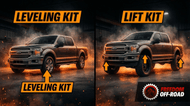
A leveling kit is exactly what it sounds like. It raises the front of the truck only, bringing it up to match the height of the rear — and nothing else.
How It Works
Most leveling kits are simple spacers that mount between the factory suspension components (struts, torsion keys, or coil spring perches, depending on your truck). They add 1 to 2.5 inches of front lift without replacing any of the existing suspension hardware.
What It Costs (Parts + Labor)
-
Parts: $100 – $400 for a quality kit
-
Labor: $300 – $500 if you're not doing it yourself
-
Total installed: roughly $400 – $900
For a weekend DIYer with basic tools, this is a half-day job. It's genuinely one of the more accessible truck mods out there.
What You Get
-
A level, aggressive stance
-
Room for modestly larger tires — typically up to 33", depending on your make/model
-
A cleaner look without dramatically altering the truck's behavior
-
Better aesthetics if you're running a heavy front bumper or a snow plow (the extra weight can actually use the lift)
Leveling Kit Is Probably Right for You If:
-
You want a cleaner look without major modifications
-
You're a daily driver who hits dirt roads occasionally
-
Budget is a priority
-
You're not planning big tires or serious trail use
What Is a Lift Kit?
A lift kit raises both the front and rear of the truck, increasing overall ground clearance uniformly. This is a more involved modification — and a more capable one.
How It Works
Unlike a leveling kit, a lift kit actually modifies or replaces suspension components: springs, shocks/struts, control arms, and sometimes the entire front and rear suspension geometry. The result is a truck that sits significantly higher than stock across the board.
The Three Types of Lift Kits
1. Spacer/Leveling Combo Kits A step up from a pure leveling kit — adds rear lift spacers in addition to front leveling hardware. Good entry point for a balanced, taller stance.
2. Suspension Lift Kits Replaces factory springs and shocks with taller, stronger components. This is the most common type for serious off-road use and larger tire fitment. Kits typically range from 2" to 6"+.
3. Coilover Lift Kits High-end upgrades that replace the entire front suspension with adjustable coilover shocks. Maximum performance, maximum price — but also maximum tunability.
What It Costs
-
Parts: $500 – $5,000+ depending on kit type, brand, and lift height
-
Freedom Off-Road kits: $360 – $1,590 with a lifetime warranty on most components
-
Labor: $500 – $2,000+ depending on complexity
What You Get
-
2" to 6"+ of lift at both ends
-
Room for 33" to 37"+ tires (depending on lift height and your specific truck)
-
Real, meaningful ground clearance for trails, rock crawling, and overlanding
-
A dramatically different truck — visually and functionally
Lift Kit Is Probably Right for You If:
-
You actually go off-road — trails, rocky terrain, overlanding routes
-
You want 33"+ tires with proper fitment and no rubbing
-
Ground clearance is the priority, not just looks
-
You're building a dedicated off-road rig or a show truck with presence
The Hidden Costs Nobody Talks About
Here's where most comparison articles let you down: they stop at the kit price. But the kit is just the beginning. Whether you go leveling or lift, budget for these:
Wheel Alignment: $100 – $200 (Non-Negotiable)
After any suspension change, you must get a fresh alignment. Skipping this destroys your tires and creates handling issues. This is not optional.
Upper Control Arms (UCAs): $400 – $820
If you're running a leveling kit over 2" on certain trucks (notably Toyota Tacoma, Tundra, and others), the factory upper control arms can be pushed to the edge of their design range. Aftermarket UCAs protect your CV axles and restore proper geometry. Not every truck needs them, but many do — check fitment guides for your specific vehicle.
Differential Drop Kit: $30 – $60
For lifted trucks with front differentials, a diff drop kit helps maintain proper driveshaft angles and reduce vibration. A small expense that can save you bigger headaches later.
Tires: $1,500 – $3,000+
The lift is just the foundation. If you want to run bigger rubber, budget for a full set of new tires. Quality off-road tires aren't cheap — but they complete the build.
MPG: Expect –1 to –3 MPG
Taller tires and increased aerodynamic drag will affect fuel economy. It's not catastrophic, but it's real. Factor it in to your monthly budget.
Quick Comparison: Leveling Kit vs Lift Kit
|
Leveling Kit |
Lift Kit |
|
|---|---|---|
|
Front lift |
1"–2.5" |
2"–6"+ |
|
Rear lift |
None |
Yes |
|
Tire clearance |
Up to ~33" |
33"–37"+ |
|
Parts cost |
$100–$400 |
$360–$5,000+ |
|
Total installed |
$400–$900 |
$1,000–$7,000+ |
|
Install difficulty |
DIY-friendly |
Moderate to complex |
|
Off-road capability |
Minor improvement |
Significant improvement |
|
Best for |
Daily drivers, aesthetics |
Trail use, big tires, builds |
What About Your Specific Truck?
Fitment matters. A lot. The right kit for a Ford F-150 is different from what works on a Toyota Tacoma or a Ram 2500. Clearance, CV axle geometry, control arm design, and coil vs. torsion bar setups all factor in.
Freedom Off-Road builds kits specifically for:
-
Toyota: Tacoma, 4Runner, Tundra
-
Ford: F-150, F-250, F-350
-
Chevy/GMC: Silverado, Sierra
-
Ram: 1500, 2500, 3500
-
Lexus: GX
Every kit is engineered for the specific vehicle — not a universal-fit afterthought. And with a lifetime warranty on most components, you're not gambling on quality to save a few bucks.
The Bottom Line
If you want a level stance, room for modestly larger tires, and a clean look on your daily driver, a leveling kit is the smart, budget-friendly choice. It's simple, effective, and easy to install yourself.
If you're serious about off-road capability, want to run big tires, or you're building a rig that can actually handle technical terrain, a lift kit is the investment that gets you there.
Either way: don't forget the alignment. And don't skip the UCAs if your setup calls for them.
Ready to Upgrade? Browse Freedom Off-Road's Full Catalog
Whether you're leveling out your daily driver or building out a dedicated trail rig, Freedom Off-Road has you covered — with premium-quality kits at prices that won't make you wince.
Shop truck-specific leveling kits, suspension lift kits, and everything in between at freedomoffroadusa.com.
Find your vehicle. Find your kit. Hit the road — or the trail — with confidence.